Quick takeaways
- Visit Iran documents needlework as an important handicraft of Sistan and Baluchestan, but the regional tradition does not prove the maker of an individual item.
- Inspect stitch tension, outlines, thread security, ground cloth and reverse before comparing decoration density.
- For a bag or garment, evaluate seams, lining, zip, strap and load-bearing points separately from the embroidered panel.
- Ask who made the work and how the maker was paid when provenance and responsible purchasing affect your choice.
Choose the format for a real recipient and use
Begin by deciding whether the embroidery should be a framed panel, garment detail, pouch, bag, cushion face or small decorative textile. Each format faces different wear. A wall piece may prioritize visual composition, while a bag must also survive repeated opening, weight, abrasion and contact with other objects.
Measure the recipient’s likely use rather than buying the largest field of embroidery. For an unfamiliar recipient, a compact pouch, framed panel or cushion face may be easier to place than clothing with uncertain sizing. A useful format keeps the craft visible instead of turning it into a delicate object nobody dares handle.
Keep regional context separate from product provenance
Official tourism material places needlework within the handicrafts of Sistan and Baluchestan and provides cultural context for the tradition. It does not identify the person who stitched a particular market item, the exact village, the age of the work or the conditions under which it entered the finished product.
Ask for the maker, community, workshop or cooperative information in writing when it affects price or responsible-purchase decisions. A seller may honestly know only part of the chain. Preserve that limit. Do not transform a general regional story, a motif or a purchase location into certain individual provenance.
Inspect the ground cloth and overall tension first
Spread the embroidered area without pulling it. Look for holes, stains, brittle cloth, severe puckering and repairs. The ground textile carries the stitches, so a dense pattern cannot compensate for a weak foundation. Check whether the panel was cut from an older piece and whether that history is disclosed.
View the surface from a low angle. Gentle hand-made variation is normal, while strong ripples or pulled corners may signal uneven tension or poor mounting. Compare the embroidered area with adjoining plain cloth. If the panel has been attached to a bag, check that the sewing line does not cut through vulnerable motifs.
Read stitch control instead of counting colors
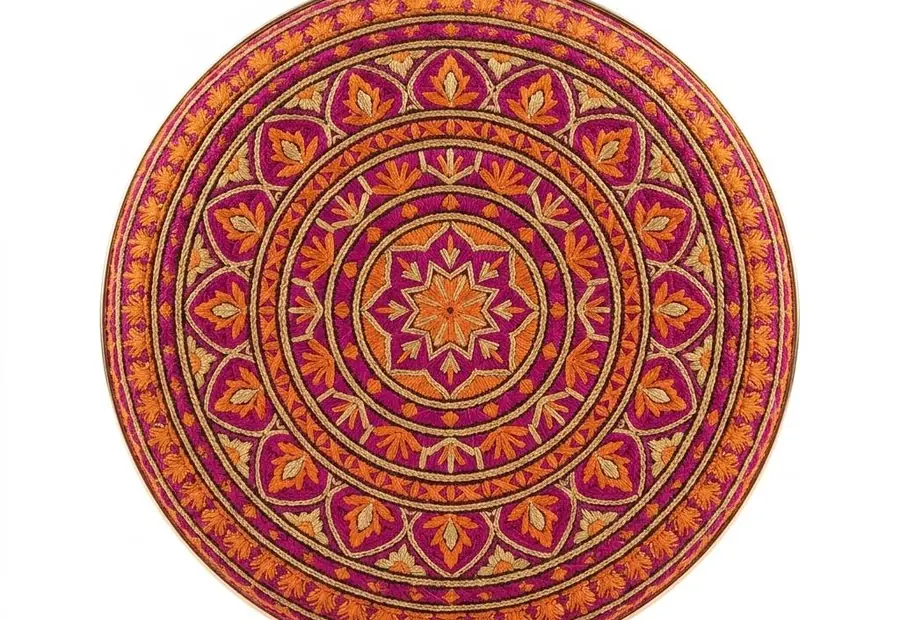
Follow outlines, fills and changes of direction across several parts of the design. Look for intentional spacing, controlled tension and secure thread changes. Bright color and dense coverage can be attractive, but neither proves workmanship when loops are loose, outlines repeatedly drift or thread ends are exposed to snagging.
Small differences are consistent with hand work and should not be judged against machine uniformity. Ask whether variation feels coherent across the composition. Inspect high-friction points closely. A stitch that is safe on a framed textile may be vulnerable on the lower corner of a frequently carried bag.
Turn the work over when construction allows
The reverse can reveal knots, thread paths, loose ends, repairs and whether the maker controlled long floats. It need not look identical to the front, yet uncontrolled tangles can catch and abrade. If a lining hides the reverse, ask whether it can be inspected before final assembly or how it is protected.
Do not demand that a seller dismantle a finished product. Instead, inspect any visible reverse at pockets and openings, and ask what lies between embroidery and lining. A protective backing may be useful on a bag, provided it is cleanly installed and does not pull or permanently distort the textile.
Audit the finished bag or garment separately
For a bag, check seams, lining, zip, magnetic closure, strap anchors, handles and corners. Open and close hardware gently several times. The embroidery may be excellent while the bag construction is weak, or the reverse may be true. Price and intended load should reflect both layers.
For clothing, inspect sizing, seam allowance, lining and how embroidery sits near elbows, cuffs or openings. Ask about alteration before buying. Do not place all value on the decorative panel if a broken zip or unstable strap will make the finished object unusable soon after the journey.
Avoid invented motif meanings and authenticity shortcuts
Motifs can carry family, local, aesthetic or personal significance, but one universal interpretation should not be invented without a reliable source or maker explanation. Invite the maker’s account when available and present it as that maker’s account, not an automatic meaning for every Balochi design.
Likewise, bright color, irregularity, visible knots or claims of old pattern do not independently authenticate an object. Responsible evaluation combines material condition, stitch control, construction and documented provenance. An honest contemporary item can be a more meaningful gift than a vague antique-style claim.
Compare price and maker benefit transparently
Compare format, dimensions, embroidery coverage, stitch control, ground cloth, finishing, hardware, condition and maker information. A small panel may represent substantial skilled labour; a large bag may devote much of its price to leather-like trim or retail presentation. Ask what specifically explains the total.
When responsible purchasing matters, ask whether the shop works directly with makers, a cooperative or an intermediary and whether a maker card is available. Do not claim a verified income share without evidence. The useful goal is traceability and a respectful question, not a marketing story that the buyer cannot support.
Plan care, packing and a final audit
Request care guidance for both textile and finished object. Avoid bleach, rough machine washing, prolonged dampness and strong direct sun unless reliable instructions say otherwise. Spot treatment can spread dye or mark the ground cloth, so valuable or uncertain work should receive conservative specialist advice.
For travel, keep the item dry, support hardware and avoid sharp folds across embroidery. Isolate it from liquids, cosmetics and abrasive fasteners. Before paying, confirm recipient, format, cloth, stitchwork, reverse access, seams, lining, hardware, maker information, care, packing and price. Reject active damage or unsafe construction.
Frequently asked questions
Does dense stitching always mean better Balochi embroidery?
No. Density may reflect labour, but quality also depends on ground cloth, controlled tension, secure transitions, coherent design, condition and suitability for the product’s use.
Why inspect a bag separately from its embroidery?
The textile panel and the finished bag have different failure points. Seams, lining, zip, handles, strap anchors and corners must support the intended load.
Can a motif prove where the embroidery was made?
A motif can provide context but does not by itself prove maker, village, age or production chain. Ask for specific provenance and keep uncertainty visible.
How can I buy more responsibly?
Ask who made the work, whether a maker or cooperative card exists, and how the shop knows its provenance. Do not repeat an income or direct-trade claim without evidence.
How should embroidered products be packed?
Keep them dry, protect stitches from abrasion, support hardware, avoid sharp folds and isolate the item from liquids, cosmetics and rough luggage fittings.
Sources and notes
The date beside a source is its recorded access date, not confirmation that the link works today or that the whole article has just been reviewed. The article’s update date is shown separately.
- Balochi Embroidery (Sistan and Baluchestan) — Visit Iran
Recorded source access: - Handicrafts of Sistan and Baluchestan — Visit Iran
Recorded source access: - Sistan and Baluchestan Province — Visit Iran
Recorded source access: