Quick takeaways
- Visit Iran describes Kalpurgan pottery as hand-built without a potter’s wheel, but that documented tradition does not automatically verify every object offered under the name.
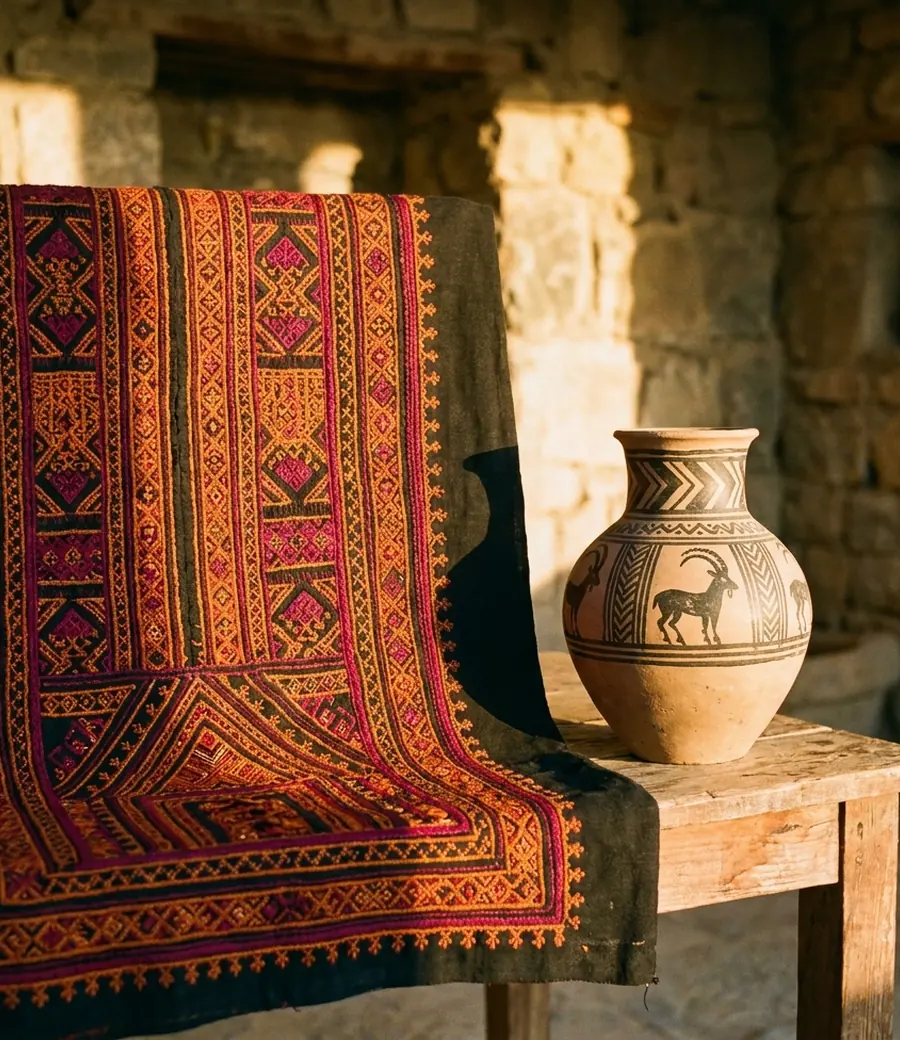
- The current repository image shows regional embroidery, not Kalpurgan pottery; inspect the actual ceramic object rather than using the illustration as product evidence.
- Check rim, wall, joins, base, cracks, chips, repairs and stability while respecting intentional hand-built variation.
- Ask the maker or responsible seller whether the individual piece is decorative or intended for a particular use; appearance alone cannot establish food safety.
Begin with use, recipient and travel limits
Decide whether the object is a decorative vessel, display sculpture, small container or a gift that the recipient expects to use. Intended use changes the questions about surface, cleaning, liquids, heat and stability. Reserve suitcase space before shopping because hand-built pottery still requires a rigid protective box.
A compact piece with limited projections is usually easier to stabilize than a wide rim or tall narrow neck. For an unfamiliar recipient, decorative use may be clearer and lower risk when product-specific functional guidance is absent. The best souvenir is one that can be displayed honestly and arrive intact.
Understand the documented Kalpurgan tradition
Visit Iran describes Kalpurgan pottery as a village tradition formed by hand without a potter’s wheel and provides useful context for the craft. This characteristic distinguishes the production story, but it does not let a visitor authenticate an individual item solely from irregular form or a seller’s label.
Ask where the object was made, who made it and whether a maker or workshop card is available. Keep the village tradition separate from the product chain. If the seller cannot connect the piece to Kalpurgan, describe it conservatively as pottery sold in the regional context rather than certain village production.
Respect hand-built variation while checking condition
Hand-building can produce purposeful asymmetry, finger shaping and differences between pieces. Those qualities should not be rejected simply because they are not wheel-perfect. At the same time, intentional variation is not a blanket excuse for active cracks, unstable bases, loose joins or sharp broken edges.
Rotate the piece slowly under even light. Compare the whole silhouette and ask the maker about unusual marks. A coherent irregular form can be sound, while a line that continues through the wall or changes when gently viewed from both sides may deserve closer condition discussion.
Inspect rim, wall, joins and base
Look closely at the rim, handles, applied elements and any transition between neck and body. Search for chips, open cracks, poorly bonded attachments and visible repair. Do not scratch the surface or force a handle. Every object in a group should receive its own inspection before wrapping.
Place the piece on a flat protected surface and check whether it stands as intended. Examine the base for damage and projections that could scratch furniture. Ask whether an irregular base is a design choice or requires a support ring, and make sure that support is included when needed.
Read surface and decoration without inventing meanings
Observe the surface for flaking, abrasion, impact marks, unexpected powder and filled lines. Natural variation from materials and firing may be part of the object, so ask for explanation rather than imposing an industrial standard. The goal is a stable surface whose current condition is understood.
Treat painted or drawn marks as visual craft information, not a universal symbolic language. Do not assign one fixed meaning to every geometric sign without a source or maker account. When a maker explains a motif, preserve the attribution instead of generalizing it to the entire tradition.
Separate decorative appeal from functional claims
Do not infer suitability for food, water, heat, microwave, oven or dishwasher from colour, lack of glaze, smoothness or a traditional appearance. Ask a responsible maker or seller what the individual object is intended to do and request care guidance. Different uses require different product information.
If the answer is unclear, keep the piece decorative and tell the recipient. This is not a judgement against the tradition; it is a cautious boundary around an individual product claim. Do not conduct improvised acid, soaking, scratch or heat tests that could damage the object.
Ask about maker provenance and responsible purchase
Maker information can turn a general regional purchase into a traceable craft connection. Ask for the maker’s name, village or workshop and how the shop obtained the item. A card or receipt is more durable than a story remembered after travel. Record only what the seller can support.
If responsible purchasing matters, ask whether the seller works directly with makers or through an intermediary. Do not invent a guaranteed income share or direct-trade benefit. A respectful question and honest chain are better than a philanthropic claim with no evidence.
Compare price across comparable objects
Compare dimensions, complexity of hand-building, attachments, decoration, condition, maker documentation and included packing. A small coherent object may take meaningful skill, while a larger piece may be simpler. Weight and size alone do not measure labour, provenance or practical value.
Ask why two similar pieces differ in price and listen for concrete factors. Keep the receipt when maker or origin claims matter. Include packing in the total: a cheap object with inadequate protection can become the most expensive choice when it breaks before reaching the recipient.
Pack in layers and finish with an audit
Cover the surface with a clean non-abrasive layer, cushion the entire body and reinforce the rim and projections without pressing them inward. Use a rigid box, separate multiple pieces and fill empty space so nothing moves. Keep the box away from luggage wheels, liquids and heavy objects.
Before paying, confirm intended use, form, rim, wall, joins, base, surface, repairs, maker information, care, packing and total price. Photograph the object and label with permission. Reject active cracks, loose attachments, sharp chips or a box that allows movement. Honest limits protect both craft and recipient.
Frequently asked questions
Is Kalpurgan pottery made without a wheel?
Visit Iran describes the village tradition as hand-built without a potter’s wheel. That documents the craft context, while an individual object still needs specific provenance.
Does irregular form mean the pottery is damaged?
Not necessarily. Hand-building can create intentional asymmetry. Inspect for active cracks, loose joins, sharp chips, unstable bases and unexplained repairs separately.
Can I use every Kalpurgan vessel for food or water?
Do not assume so from appearance. Ask a responsible maker or seller about the intended use of that exact product and keep it decorative when guidance is unclear.
How can I verify maker provenance?
Ask for the maker, village or workshop and request a card or receipt. A motif, irregularity or place of sale alone cannot prove the production chain.
How should Kalpurgan pottery be packed?
Use a non-abrasive surface layer, full cushioning, reinforced protection for rims and projections, a rigid box and filled empty spaces so the object cannot move.
Sources and notes
The date beside a source is its recorded access date, not confirmation that the link works today or that the whole article has just been reviewed. The article’s update date is shown separately.
- Kalpurgan Pottery — Visit Iran
Recorded source access: - Kalpurgan Village — Visit Iran
Recorded source access: