Quick takeaways
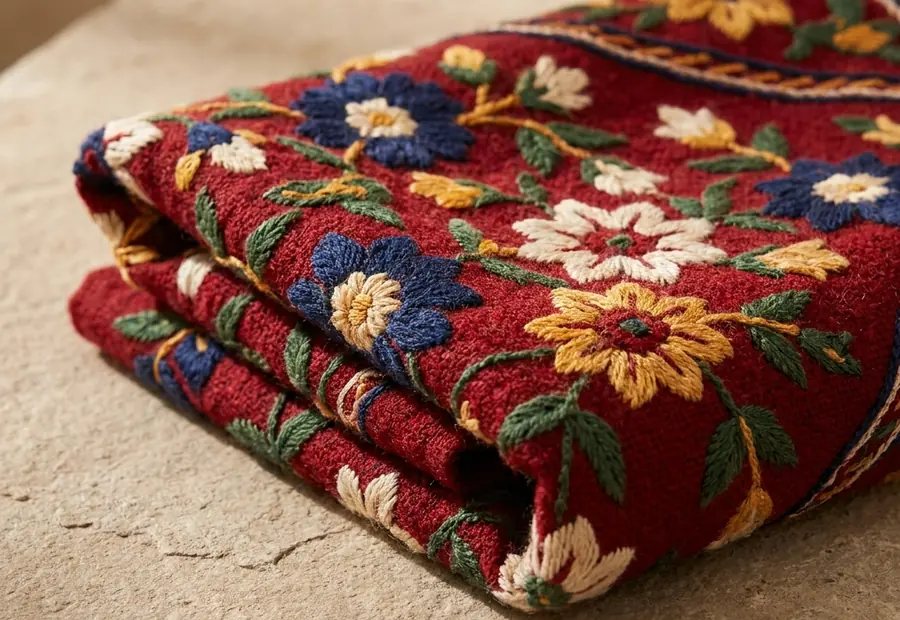
- Pateh is a Kerman embroidery tradition worked on a woollen ground cloth, but a regional label alone does not prove the history of an individual piece.
- Inspect both front and reverse; dense decoration is not automatically better when tension, edges or the ground cloth are weak.
- Choose the format for a real use such as a runner, cushion, framed panel or small table textile before comparing prices.
- Ask for maker or workshop information in writing when provenance materially affects the price.
Begin with the recipient and a realistic use
A pateh panel can be a table textile, runner, cushion face, framed work or ceremonial gift, and those uses demand different dimensions and finishing. Measure the destination before shopping. A highly detailed piece still becomes an awkward gift when it does not fit the table, frame or home routine of the recipient.
For an international or unfamiliar recipient, a smaller runner, cushion face or framed panel is often easier to place and explain than a large cloth. Ask whether the recipient can manage specialist textile care. Practical fit is not a lesser standard than visual beauty; it protects the work from being folded away indefinitely.
Understand what the regional name can and cannot prove
Visit Iran identifies pateh-douzi with Kerman and describes embroidery on a woollen ground, providing useful cultural context. That source supports the tradition, not the exact maker, age, fibre content or production history of every item offered in a market. Keep the distinction clear when describing the gift.
If a seller names a village, workshop, artist, age or competition award, request a label, receipt or maker card that records the claim. A compelling oral story may start a useful conversation, but it should not be silently converted into documented provenance. Unverified details can simply remain unverified.
Inspect the ground cloth before admiring the motifs
Spread the piece on a clean flat surface and inspect the woollen ground for holes, severe distortion, stains, brittle areas, repairs or unexplained colour differences. Embroidery can visually dominate the cloth, yet the ground carries every stitch. A weakened foundation may shorten the useful life of an otherwise attractive design.
Look along the surface from a low angle. Mild hand-made variation is compatible with craft, while strong rippling, puckering or pulled corners can indicate uneven tension or storage problems. Ask whether any backing, lining or stiffener is permanent, because hidden construction changes both inspection and later care.
Read stitch control rather than counting decoration
Compare several areas instead of selecting the densest patch. Look for controlled tension, coherent direction, secure transitions and intentional spacing. Dense stitching may require more labour, but density alone does not establish skill when threads snag, the cloth buckles or broad areas appear rushed.
Examine how curves, borders and changes of colour are handled. Small differences are natural in handwork and should not be treated as defects by default. The useful question is whether variation supports the overall design or repeatedly disrupts outlines, leaves loose loops and exposes vulnerable thread ends.
Turn the work over and inspect edges and finishing
The reverse can reveal thread paths, knots, repairs, loose ends and the discipline of the construction. It need not resemble a machine-made surface, but it should not contain uncontrolled tangles likely to catch. If a lining prevents inspection, ask why it is present and how the item should be maintained.
Check hems, corners, joins, zips and mounting points according to the intended format. A cushion face needs different finishing from a framed panel. Clean edges protect the embroidery during use, while an attractive central field cannot compensate for a seam already opening or a corner cut out of square.
Evaluate colour, fading and condition conservatively
Compare exposed and protected areas for pronounced fading, transfer, staining or abrasion. Colour variation may arise from design, materials, light or age; appearance alone cannot prove natural dye, antiquity or a particular date. Treat those as separate claims requiring evidence rather than attractive visual inference.
Ask whether the piece is new, previously used or restored, and request disclosure of repairs when condition affects value. A sound repair is not automatically a reason to reject a piece, but the buyer should know what is being purchased. Avoid aggressive rubbing or wet tests that could damage textile fibres.
Compare prices on equivalent specifications
Record dimensions, ground material, stitch coverage, finishing, maker information, condition and included presentation before comparing two pieces. Price per area is too crude because a small controlled work may require more skill than a larger repetitive field. Decorative packaging can also raise the total without improving the textile.
Ask the seller to explain a large price difference in concrete terms: labour, materials, named maker, workshop documentation, complexity or condition. Phrases such as museum quality, antique style or first grade need definitions. Keep the receipt when provenance, fibre or restoration statements influence the purchase.
Plan care, display and travel before payment
Request written care guidance. Avoid prolonged dampness, strong direct sunlight, rough washing, bleach and high heat unless a qualified conservator or reliable maker instruction says otherwise. For valuable or uncertain pieces, conservative professional textile cleaning is safer than improvised stain treatment.
For travel, place clean tissue or a colour-safe barrier against the surface, avoid sharp folds and isolate the embroidery from liquids, cosmetics and rough hardware. Roll only when the format and construction permit it; otherwise use broad gentle folds with support. A rigid outer layer can prevent crushing in luggage.
Complete a one-minute purchase audit
Before paying, confirm recipient, dimensions, use, ground condition, stitch control, reverse, edges, repairs, maker information, care instructions, packing and total price. Photograph the piece and any label with permission. These records help the recipient understand the object without adding unsupported claims.
Reject active damage, strong unexplained odour, dampness, brittle cloth, severe distortion or finishing that cannot survive the intended use. A good pateh gift is not necessarily the busiest or largest one. It is a coherent, well-finished textile whose known history, practical role and care burden are honestly communicated.
Frequently asked questions
Is denser pateh embroidery always better?
No. Density may reflect labour, but quality also depends on controlled tension, sound ground cloth, coherent design, secure finishing, condition and suitability for the intended use.
Why should I inspect the reverse of pateh?
The reverse can show thread paths, knots, loose ends, repairs and construction discipline. A lining may limit inspection, so ask how and why it was attached.
Can appearance prove that a pateh is antique or naturally dyed?
No. Colour and wear alone cannot reliably establish age, dye source or provenance. Ask for specific documentation and keep uncertain claims qualified.
What pateh format is easiest to give as a gift?
A small runner, cushion face or framed panel is often easier to place and transport, but the best format depends on the recipient’s space, taste and ability to care for textiles.
How should pateh be packed for travel?
Protect it from moisture, abrasion and sharp folds with clean colour-safe materials, stabilize it inside luggage and follow maker or professional care guidance for valuable pieces.
Sources and notes
The date beside a source is its recorded access date, not confirmation that the link works today or that the whole article has just been reviewed. The article’s update date is shown separately.
- Pateh Douzi of Kerman — Visit Iran
Recorded source access: - Kerman Province — Visit Iran
Recorded source access: