Quick takeaways
- Narges and Kaveh are fictional Shirazi siblings travelling with their family. This episode can be read on its own.
- Seh-Rah guesthouse, the instructors and every game station are invented. This is not a bookable experience or an underground route.
- The sources support Yazd's water and architectural context, cotton zilu and Meybod's craft-city listing. The number 632 belongs only to the invented game.
- For choosing a textile or comparing edible gifts, use the English zilu and Yazd souvenir guides linked below.
The map with a missing blue line
Kaveh unfolded the map for the third time. It showed lanes, a courtyard and even a flowerpot beside a doorway, but the blue line stopped in the middle of the page. Narges lifted her tea glass before it left a ring. Their family was having breakfast at Seh-Rah, an imaginary guesthouse in Yazd. Beside a folded zilu lay three envelopes and an instruction: find the way that makes a home work. Unlike their Isfahan adventure, this puzzle had no missing gift label. The map itself seemed incomplete.
Sara, the game's fictional designer, handed Narges the pattern envelope; her colleague Amin gave Kaveh the route sheet. Their parents stayed at the table while the siblings compared their clues. Three cards were numbered: water, 6; air, 3; thread, 2. A second instruction asked them to identify what travels unseen, what arrives from above and what remains underfoot. Kaveh reached for a lock that wasn't there. Narges turned the envelope over. Perhaps they needed to understand the question before hunting for somewhere to put the numbers.
Look beneath the street plan
Kaveh joined two lanes with a pencil, then tried another pair. Every route ended at a wall. Narges lifted a corner of the sheet and found a thin overlay underneath. The blue line continued across it. Aligned with the street plan, it passed below the drawn houses and reached the courtyard symbol. The envelope's factual note pointed to UNESCO's account of Yazd: qanats bring water through underground channels. A street picture without visible water did not mean that no water route existed.
Some paths cannot be understood from the surface alone, Narges wrote. Kaveh wondered whether their next clue was down a staircase. Their mother tapped the paper: the whole route was already on the table. No well, tunnel or closed doorway was part of this game. The overlay was an invented teaching prop, not a plan of an actual qanat. Kaveh put his ruler away. He had been drawing increasingly complicated answers on top of a page whose useful information lay underneath it.
A courtyard is more than an empty square
On the family's later walk, Narges began noticing relationships instead of collecting isolated pictures: shade beside a wall, an opening above a roof, a courtyard inside a house. UNESCO's description connects Yazd's courtyards, thick earthen walls and windcatchers with its built environment. That was enough context for the second card. They did not need to calculate a room's temperature or guess whether a particular tower still worked. On their simplified diagram, an arrow brought air from above towards the courtyard.
Kaveh placed the water overlay below the plan and the air card above it. The white courtyard square became a meeting point for two ideas. Outside, the family kept their voices low and their camera away from private windows. Narges adjusted her headscarf and reminded her brother that other people's homes were not scenery hired for their adventure. He closed the map until they reached a suitable stopping place. Curiosity could make them more attentive guests without making residents responsible for entertaining them.
Keep Meybod's name on the map
The thread envelope named Meybod. Kaveh almost wrote Yazd over it to make his notes simpler. Narges stopped him: Meybod is a city in Yazd province, not another name for Yazd city. The World Crafts Council's Asia-Pacific list identifies Meybod with zilou, also written zilu. That recognition supplied context for the craft, not a certificate for every object in a shop. The siblings kept both place names. A tidy notebook was not worth losing the difference between a province and one of its cities.
Their next fictional learning table was in Meybod. Travel times and transport arrangements were outside the puzzle; there was no itinerary to copy. Sara set blue and white paper strips in front of Narges, while Amin gave Kaveh a squared sheet. Their mother asked them to read the final sentence before starting. Usually Kaveh's hands got ahead of the instructions. This time he waited. Patience, Narges thought, might be the lightest thing they could carry home, though it was proving surprisingly difficult to pack.
The row that would not be skipped
Visit Iran describes zilu as a cotton textile with geometric patterns. Sara's paper exercise borrowed the idea of ordered crossings, not the full technique of weaving a zilu. Narges passed strips alternately over and under one another. Kaveh marked the corresponding squares, but skipped a row to catch up. From a distance the arrangement looked convincing. When he tried to extend the border, two lines no longer met. The error had travelled quietly through the pattern and appeared at its edge.
He suggested cutting the corner away. Narges moved the scissors aside and asked where the mismatch had begun. They loosened several strips, corrected the missing row and rebuilt the border. It took longer than hiding the mistake, but nothing needed throwing away. The folded textile stayed untouched: paper was their practice material, not permission to experiment on somebody else's work. Kaveh looked at the repaired pattern. His shortcut had not saved work; it had moved the work to a less convenient place.
The square they must not fill
One white square remained in the finished pattern. Kaveh searched under the table for another piece. Narges laid the courtyard plan over the grid. The empty square matched its doorway. Filling it would close the entrance on their paper model. The third envelope allowed them to move just three pieces: a seating area, a tray and a passage. The task was no longer to make the fullest or most elaborate arrangement. They had to find one in which every piece allowed the others to work.
In the first attempt the tray blocked the passage. In the second, the border looked beautiful but one guest had nowhere to sit. Their mother played that last guest and asked a simple question: where would she go? Narges shifted the seating piece back; Kaveh left the approach clear. These paper dimensions were not architectural or safety guidance for a real room. Yet the small game made a larger point visible. A welcoming arrangement has to consider the person arriving, not only the objects already inside.
Make room for the tea break
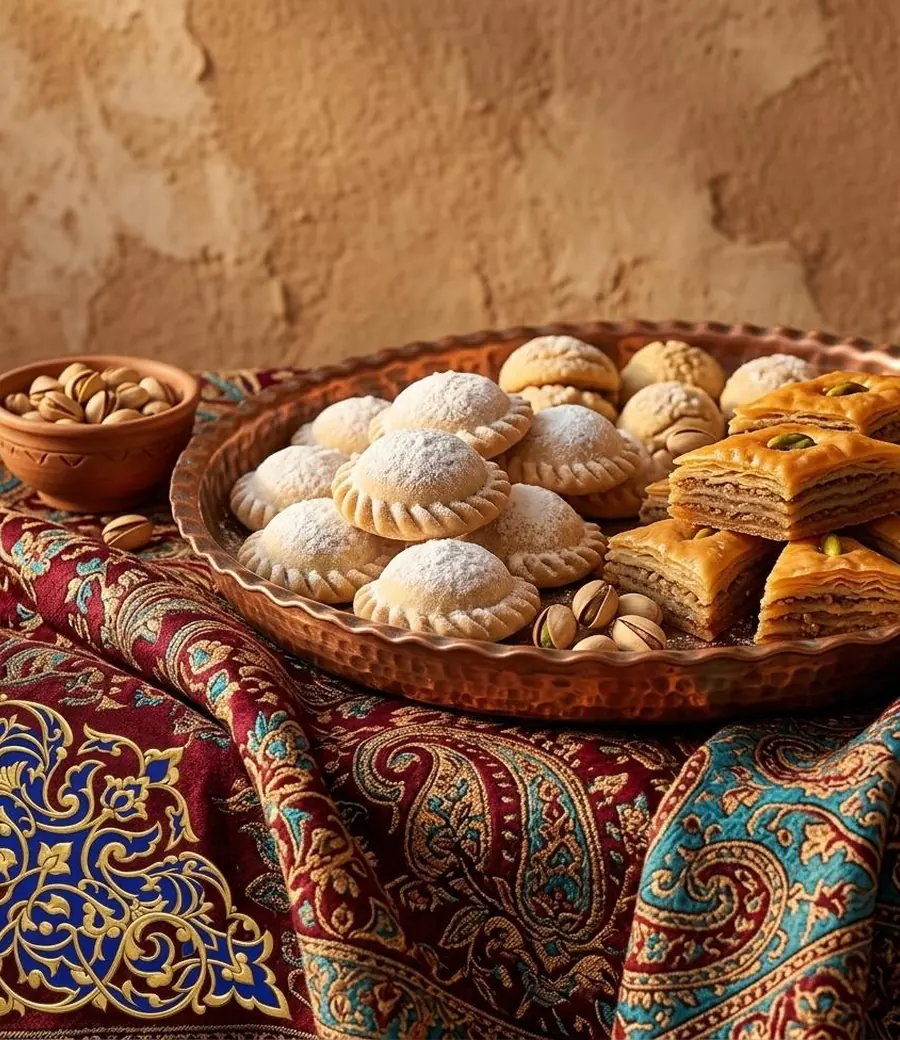
Their father brought the family's box of sweets. Kaveh nearly set it on the map's newly cleared corner. Narges laughed: they had just spent all that effort keeping it open. They put the game away and brought out a separate tray. Talk turned to qottab and the edible gifts associated with Yazd. Nobody tried to identify every ingredient by appearance. For an actual food gift, the information on the particular package and the recipient's needs mattered more than the city name on the lid.
After tea, Kaveh wanted to put the paper strips, map and food packet into one bag. Their mother found a folder so crumbs and grease would not spoil the clues. Narges saved two spare strips for explaining the puzzle to their grandmother. The useful souvenir was not yet a large purchase or a complete collection. It was a story they could retell, pieces they had kept in good condition and time spent together. Leaving a little room was beginning to feel like a deliberate choice rather than a missed opportunity.
Water, air, thread: 632
Sara returned the three envelopes to the table. Each now had a matching place on the notebook cover. Narges read the first clue: what travels unseen. Water, card 6, went beneath the map. Kaveh read the second: what comes from above. Air, card 3, followed. Thread, card 2, completed the sequence with the textile underfoot. They wrote 632 on the answer sheet. These were arbitrary game numbers, not dates from Yazd's history or a secret traditionally woven into real zilu.
On the reverse was a complete picture of their family table. The water line, open doorway and orderly strips made sense together. Kaveh asked whether anything had really been missing. Their way of looking, Narges suggested. Their father handed them the notebook as their prize. They could recreate the adventure without taking an object from a historic place or damaging a textile. The folded zilu remained where it belonged. What travelled with them was a way to notice connections that had been present all along.
Take a better question home
Narges's last note was not to call every textile by the same name. Zilu and termeh lead to different conversations. The English zilu guide below is the next stop for questions about the textile, dimensions and care; the Yazd souvenir overview separates gift categories, and the sweets guide handles the edible choices. This story does not replace those buying guides. Its purpose is to make the next question more thoughtful: what is this object, whose work does it represent, and how will someone use it?
Before closing the folder, Kaveh opened their larger map of Iran. Beside Isfahan he drew the blank gift label; beside Yazd, the three connected clues. He left the next city unmarked. An empty space did not need an invented promise to fill it. Each adventure would need its own facts and its own puzzle. Narges suggested beginning their account to their grandmother with the white square. If they had covered it, the final guest would still have been waiting outside.
Frequently asked questions
Can I book this game in Yazd or Meybod?
No. The guesthouse, instructors and learning tables are fictional. The story does not advertise a working escape game, workshop appointment or underground visitor route.
Does 632 have a historical meaning in zilu weaving?
No. The card numbers and their sequence were invented for this story. The sourced architectural and craft context does not give the cipher a historical or religious meaning.
Are Meybod and Yazd the same city?
No. Meybod is a city in Yazd province. Its zilu association appears under Meybod in the World Crafts Council's craft-city list.
Does the paper exercise teach authentic zilu weaving?
No. It illustrates how a pattern depends on consistent rows. It is neither a production tutorial nor an authenticity test; follow the linked zilu guide for buying questions.
Must I read the earlier episodes first?
No. The hidden-water mystery stands alone. The related Isfahan story continues the reading path and links back to the Shiraz episode.
Sources and notes
The date beside a source is its recorded access date, not confirmation that the link works today or that the whole article has just been reviewed. The article’s update date is shown separately.
- Historic City of Yazd: qanats, courtyards and windcatchers — UNESCO World Heritage Centre
Recorded source access: - Zilu of Yazd: cotton and geometric patterns — Visit Iran
Recorded source access: - Asia-Pacific craft cities: Meybod and zilou — World Crafts Council
Recorded source access: