Quick takeaways
- UNESCO describes Meidan Emam as an integrated Safavid urban ensemble whose arcades contained hundreds of shops and whose Qeysarieh portal connects to Isfahan’s bazaar.
- Make one observation circuit before a serious purchase, then return to two or three shortlisted pieces with the same criteria.
- For handicrafts, inspect backs, edges, joins, surface finish and practical function—not only colour, size or a bright display.
- Buy fragile sweets and delicate pieces near the end of the walk, and follow the producer’s own storage and shelf-life information.
Read the square as a living commercial ensemble
Naqsh-e Jahan, also known officially as Meidan Emam, is more than a scenic stop. UNESCO presents it as the heart of a Safavid capital where ceremonial, religious, political and commercial life met. The arcades around the square historically held hundreds of shops, while the Qeysarieh portal on the north side linked the ensemble to the larger bazaar. That context explains why a visitor can encounter several Isfahan craft traditions within a compact walk.
Compactness is useful, but it encourages impulse buying. Qalamkar textiles, khatam boxes, engraved metal, enamelware, rugs and sweets may appear within minutes of one another. Decide that the square is a place to form a judgment, not a place where every category must enter your bag. The aim is to leave with a purchase whose use, recipient and transport plan are clear.
Use a three-pass route: observe, compare, return
On the first pass, avoid the main purchase. Note the available sizes, approximate price bands, packaging and visible differences in finish for only the categories you actually need. Looking at several comparable objects makes uneven edges, rough joins, excessive weight or poor scale easier to recognise than studying one isolated piece under flattering light.
On the second pass, inspect two or three finalists and ask consistent questions: what materials were used, which work was done by hand, what care is required, and how will the seller protect it for your journey? For multiples, confirm that the other units match the sample. The final return introduces a useful pause between attraction and payment; compare prices only between pieces of broadly similar material, dimensions and execution.
- First pass: observe and define a benchmark.
- Second pass: inspect a short list closely.
- Third pass: buy after checking use, finish, budget and transport.
- Photograph or note specifications only with the seller’s permission.
Judge crafts beyond the front of the display
For qalamkar, compare print boundaries, consistency, cloth quality and edge finishing. With khatam, study geometric order, smoothness, corners and the less visible underside. For ghalamzani, compare control of the lines, consistency of depth and the metal surface. With minakari, check the form and glaze for obvious chips or cracks and look for clean execution rather than assuming that a crowded blue design is automatically superior.
Turn an object over, open a box, inspect the base of a vessel and test a lid or hinge gently when appropriate. A piece that looks impressive only from the front but is careless at joins and hidden surfaces is a riskier formal gift. Scale is not a substitute for workmanship: a compact, well-finished object is often more useful and much easier to carry than a large average-quality piece.
Continue through Qeysarieh with higher evidence standards
The Qeysarieh entrance is not a detached attraction; UNESCO identifies it as the link between the square and Isfahan’s bazaar. Visit Iran also places the carpet bazaar near the square and describes the wider network of weaving, dyeing, finishing and repair. A market object therefore sits within a chain of skills, even though that regional context alone cannot authenticate an individual item.
For a carpet, antique claim or other high-value purchase, this general guide is not a valuation service. Slow down, request written specifications and a receipt, and do not accept claims about age, origin, materials or investment value without evidence proportionate to the price. As the financial and provenance claims rise, your documentation and willingness to walk away should rise too.
Assign each recipient a role before choosing a gift
Divide the list into personal gifts, formal gifts and multiples for relatives or colleagues. A personal gift can foreground taste and story—a useful qalamkar cloth or a small khatam box, for example. A formal gift benefits more from clean finishing, a clear function, resilient packaging and a short cultural explanation than from sheer size. Multiples demand predictable quality, low weight and disciplined budget allocation.
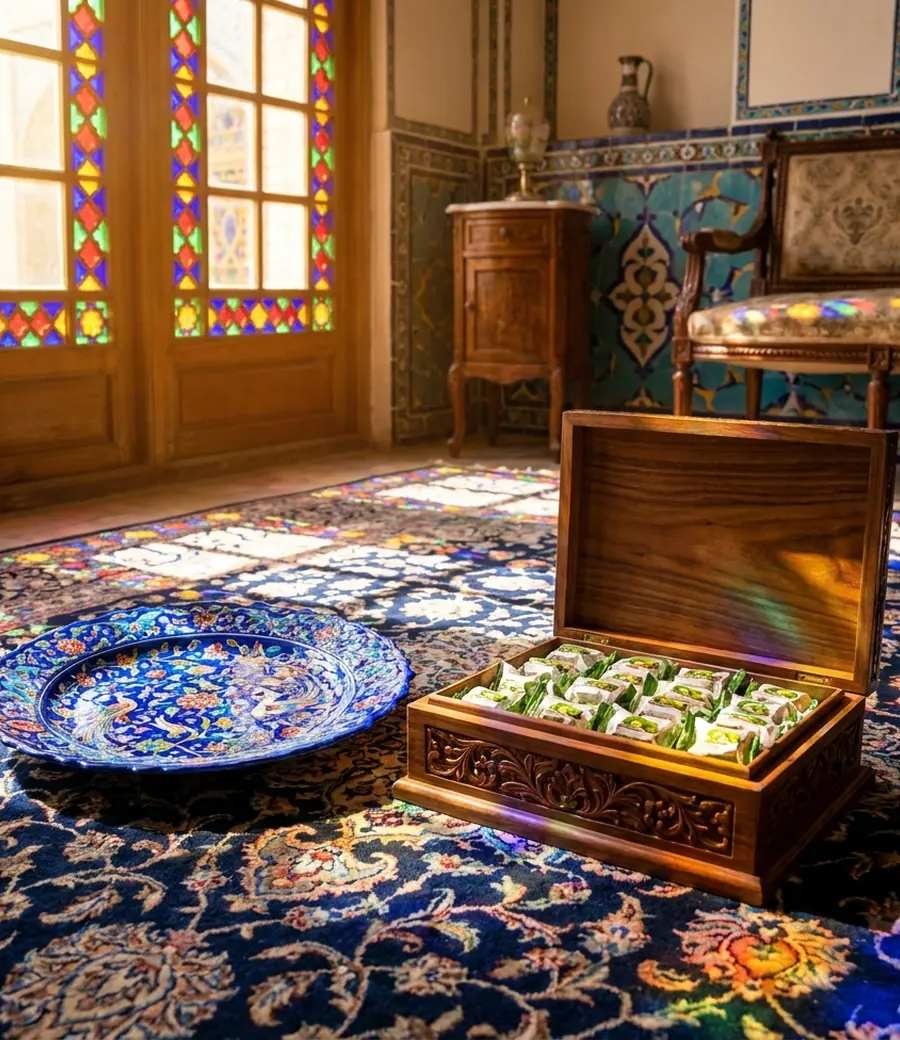
Pairing one compact craft with an edible item can be more flexible than collecting several similar objects. Reserve the durable craft for a close or formal recipient, while individually packed sweets may suit a group. This approach controls luggage and lets the gift reflect the relationship instead of forcing every recipient into the same object and price.
Buy gaz and polaki near the end of the walk
Gaz and polaki are familiar Isfahan souvenirs, but they travel differently. Thin polaki can crack under direct pressure; gaz varies by recipe and packaging and may respond poorly to heat or moisture. Buying edible souvenirs near the end reduces the hours they spend under the sun, carried by hand or compressed between harder purchases.
Read the date, seal, storage instructions and ingredient information on the specific package. This guide does not assign one shelf life or temperature to every product; the producer’s label governs. A sturdy, right-sized box that reaches the recipient intact is more valuable than decorative packaging with empty space and weak support. Smaller packs can also simplify weight distribution and sharing.
Match the package to the entire journey
Describe the real route to the seller: walking time, car or train transfer, checked or cabin baggage and any long wait in heat. Ask for rigid protection around enamel and fragile sweets, corner protection for boxes, and separation between metal objects and food. Keep dense pieces low and prevent them from sliding; do not place an engraved tray or heavy box above polaki, gaz or enamel.
For international travel, investigate current airline, customs and destination rules yourself before payment, especially for foods, plant ingredients, wood, valuable goods or unusually large objects. Rules and allowances change, and a shop’s familiarity with tourists is not official clearance. Keep receipts and ingredient labels accessible rather than burying them inside wrapped gifts.
Recognise four reasons to pause
Pause when the recipient or use is still undefined; when urgency is the only reason to buy; when a significant claim lacks a matching explanation or document; or when the packaging is plainly incompatible with the journey. None of these signs proves that a seller or object is poor. They show that the decision is not yet supported.
A living historic bazaar depends on real commerce, but cultural enjoyment and financial judgment are different tasks. Asking about materials, making, care and packaging should strengthen a serious purchase. If the piece remains persuasive after comparison and practical questions, returning to it is more meaningful than buying simply because the setting is memorable.
- No clear recipient or use.
- No comparison with a similar item.
- Important claim without proportionate evidence.
- Package cannot withstand the planned route.
Run a two-minute exit audit
Before leaving the area, count the packages and recheck surfaces, corners, box lids and food seals. Retain seller details and receipts for important purchases. Give fragile pieces a fixed protected position immediately, and keep hard crafts away from sweets and enamel. A small defect spotted at the shop is easier to resolve than one discovered after repacking.
Ask four final questions: does this suit the recipient, is the observed quality reasonable for its purpose and price, can it arrive intact, and can I explain in one or two sentences why it belongs to Isfahan? Clear answers indicate a considered souvenir. Unclear answers are permission to postpone the purchase and enjoy the square without a bag.
Frequently asked questions
Where should I start souvenir shopping around Naqsh-e Jahan?
Begin with an observation circuit through the square’s arcades and toward the bazaar. Select two or three product categories, compare similar pieces, then return to the strongest options rather than buying from the first display.
Is the area useful only for handicrafts?
No. Visitors encounter both crafts and Isfahan foods. Buy fragile or heat-sensitive edible gifts near the end, check the package label and protect them from heavier objects.
What should I inspect on an Isfahan craft?
Look beyond the face: inspect backs, edges, joins, surface consistency and any working lid or hinge. The exact criteria differ for qalamkar, khatam, metal engraving and enamel, but hidden finishing helps distinguish careful work.
Does this guide recommend particular shops or opening hours?
No. Businesses and hours can change, and no seller is ranked or endorsed here. The guide provides a comparison method for the historic square and connected bazaar.
What is a lower-risk formal gift?
Choose a small or medium piece with a clear use, clean finish, resilient packaging and a short explainable connection to Isfahan instead of relying on size or ornament alone.
Sources and notes
The date beside a source is its recorded access date, not confirmation that the link works today or that the whole article has just been reviewed. The article’s update date is shown separately.
- Meidan Emam, Esfahan — UNESCO World Heritage Centre
Recorded source access: - Isfahan carpet bazaar — Visit Iran
Recorded source access: - Meidan Emam, Isfahan — Visit Iran
Recorded source access: - Isfahan — Visit Iran
Recorded source access: