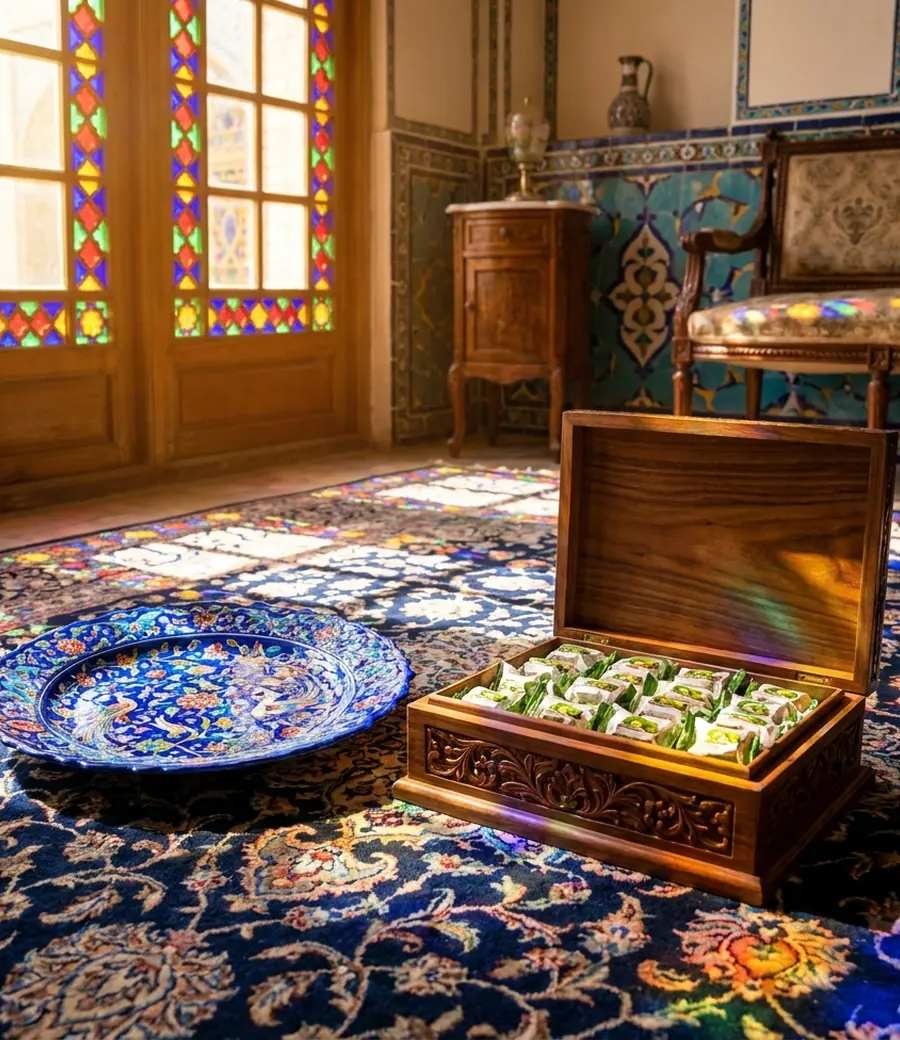
Quick takeaways
- For an easy group gift, fresh gaz in a sealed, clearly labelled box is usually simpler than a fragile craft.
- For a lasting present, consider a small minakari piece, a useful qalamkar textile or a neatly finished khatamkari box.
- Judge craft quality by alignment, edges, reverse surfaces, finish and honest information—not by pattern density or shine alone.
- A balanced Isfahan gift can pair one edible item with one compact craft instead of relying on a large decorative package.
What should you buy in Isfahan?
The short answer depends on what you need the souvenir to do. Choose gaz or polaki when you want something shareable and easy to explain at a family table. Choose qalamkar when luggage space matters and the recipient enjoys textiles or homeware. Choose a small minakari or khatamkari piece when the gift should last and carry a recognisable connection to Iranian craft. Engraved metalwork can suit a more formal recipient, but it deserves closer comparison because size, weight and workmanship vary widely.
Isfahan belongs to UNESCO’s Creative Cities Network in Crafts and Folk Art, which reflects the city’s unusually dense craft culture. That status is useful context, not a guarantee for every object on sale. A responsible purchase still begins with three questions: who is the recipient, how will the item travel, and which qualities can you actually inspect? Once those are clear, the crowded range of blue enamel, patterned cloth, wooden boxes, metal trays and sweets becomes much easier to navigate.
| Souvenir | Best suited to | Main check before buying |
|---|---|---|
| Gaz | Families, colleagues, a shareable host gift | Freshness, nut content, intact packaging and storage guidance |
| Minakari | A lasting decorative gift | Clean enamel surface, balanced form, neat edges and safe packing |
| Qalamkar | Lightweight homeware or a practical textile gift | Clear printing, useful dimensions, clean cloth and colour consistency |
| Khatamkari | A formal or personal keepsake | Aligned inlay, smooth finish, tidy corners and a well-made interior |
| Engraved metalwork | A formal gift with more visual presence | Even lines, considered design, finish, weight and transport practicality |
Gaz, polaki and other edible gifts
Gaz is the edible souvenir most closely associated with Isfahan. Encyclopaedia Iranica documents it as a confection with a long regional history, while modern versions commonly combine sweetness, egg white and nuts such as pistachio or almond. For a traveller, the most useful comparison is not the loudest box. Look for a clear production or best-before date, an intact seal, sensible ingredient information and a texture appropriate to the style. A box that has been crushed, left in strong heat or opened for prolonged display is a poor gift even if the brand name is familiar.
Nut percentage and type affect both taste and cost, but more is not automatically better for every recipient. Ask about allergens before gifting a nut-rich confection, and choose smaller individually wrapped pieces when the box will be shared at work. If the journey is long, keep sweets away from direct sun and the hot floor of a car boot. The aim is for the gift to arrive with its shape, texture and presentation intact, not merely to prove that it came from Isfahan.
Polaki—thin coin-like sweets often served with tea—can be a lighter and more economical choice. It works well in a mixed gift, especially when the recipient already knows Iranian tea culture. Because it is sensitive to moisture and breakage, a rigid container is preferable to a decorative but flimsy bag. Rock candy can also be practical, although it is less distinctly tied to Isfahan than gaz. Use edible souvenirs as the welcoming part of a gift, and let a compact craft carry the longer story.
Minakari: how to look beyond the famous blue
Minakari is the art of decorating a metal body with enamel and painted designs that are fixed through firing. Visit Iran identifies Isfahan as an important centre for this craft. The familiar turquoise and deep-blue palette is visually immediate, which makes minakari appealing to first-time visitors. Colour, however, is only the beginning of a quality check. Examine the enamel surface in steady light for obvious cracks, chips, bubbles or rough patches. Look at the rim, base and transition between painted areas rather than judging only the most detailed centre motif.
A well-resolved piece should feel balanced in shape and deliberate in decoration. Symmetry matters when the form calls for it, but a hand-decorated object need not look mechanically identical. What matters is control: lines should not appear carelessly interrupted, borders should meet cleanly, and the reverse or underside should not reveal neglected finishing. Ask what the base material is and whether the object is decorative or intended for a specific use. Do not assume that every enamelled bowl is food-safe or dishwasher-safe.
For international travel, a small plate, vase or framed piece is usually more sensible than a large showpiece. Insist on a rigid box, soft wrapping and enough filling to stop movement. If the seller cannot demonstrate safe packing, treat that as part of the buying decision. A modest, cleanly finished piece that reaches its destination safely is a better souvenir than a dramatic object whose size or fragility turns it into a travel problem.
Khatamkari and qalamkar: two very different gifts
Khatamkari is a form of geometric inlay associated with finely patterned surfaces on boxes, frames and decorative objects. It suits recipients who enjoy detail, woodwork and objects with a clear sense of hand skill. Compare pieces at a similar size rather than comparing a small refined box with a large inexpensive one. Check whether the tiny pattern units align consistently, whether the surface feels smooth, and whether corners, hinges, interior lining and less-visible edges have received the same attention as the lid.
Pattern complexity should not be mistaken for quality by itself. A restrained geometric design with precise joins can be more convincing than a crowded surface with gaps and uneven finish. For a higher-value purchase, ask for written details about materials, workshop or maker and care. A useful box also needs to open, close and sit properly; craftsmanship should support function rather than merely decorate it.
Qalamkar is the lightweight alternative. These printed or stamped textiles can become table covers, runners, cushion covers or wall pieces, and they pack flat in luggage. Choose a size the recipient can realistically use. Inspect repeated motifs for clarity, the fabric for stains or pulled threads, and the edges for neat finishing. Slight variation can reflect a hand process, but blurred printing and careless alignment are not qualities you need to romanticise. For a contemporary home, a smaller piece with a calm colour balance is often easier to live with than a very large, highly saturated cloth.
Engraved metalwork and formal gifts
Ghalamzani, or engraved metalwork, can range from small trays and plaques to large decorative vessels. It is often considered for formal or corporate gifting because it has visual weight and an obvious connection to skilled labour. The safe approach for a non-specialist is to prioritise execution over scale. Look for controlled lines, coherent composition, a finish appropriate to the metal and edges that do not feel sharp or neglected. Excessive shine and heavy weight do not prove artistic value.
Ask whether the piece is meant for display or practical use and how its surface should be cared for. If it will be carried by air, include the final packed weight in your decision. A smaller piece with maker information and a concise bilingual story card may communicate Isfahan more effectively than a bulky object selected for impact alone. For company gifts, consistency across multiple units, safe packaging and truthful documentation matter as much as the first sample.
A calm buying method for Naqsh-e Jahan and the bazaar
Naqsh-e Jahan Square and the surrounding historic bazaar place many workshops and sellers within a walkable area. That concentration is valuable because it lets you compare techniques and price levels without committing immediately. Use the first part of your visit to learn. Handle only with permission, notice how similar objects differ at the edges and reverse, and photograph labels or details only when the seller agrees. Two or three comparable examples usually teach more than a long argument over a single asking price.
For crafts, ask specific questions: What is the base material? Which stages were completed by hand? Where was it made? Is it decorative or suitable for use? How should it be cleaned? What packing is included? Clear answers do not guarantee excellence, but they make comparison possible. Vague claims such as “completely authentic” or “the best in the bazaar” are not substitutes for observable workmanship.
For more expensive items, keep a receipt and request written product information. Avoid rushed decisions created by scarcity claims you cannot verify. You are not required to identify a museum-grade object; you are trying to choose a well-made, honestly represented gift at a level you understand. That is a realistic standard for travellers and a healthier basis for supporting craft.
- Set the recipient, budget and luggage limit before entering a high-choice shopping area.
- Compare objects of similar size, material and intended use.
- Inspect the front, back, edges, joins and functional parts.
- Treat protective packing as part of the product, not an afterthought.
- Keep written details for expensive or commissioned work.
Match the souvenir to the recipient
For a host family, a box of gaz plus a small qalamkar runner creates an approachable combination: one item to share and one to keep. For a design-minded friend, a compact minakari piece can work if the colours suit their home. For a colleague, individually wrapped gaz or polaki is easy to distribute. For a formal client, a restrained khatamkari box or small engraved-metal piece may be appropriate when accompanied by accurate information rather than extravagant claims.
Children and teenagers usually benefit from lighter, less fragile choices. A sweet that fits dietary needs, a small textile item or an uncomplicated stationery box is easier than a heavy decorative vessel. Minimalist households may prefer one useful textile or a small geometric object to a full matching set. If you do not know the recipient’s taste, reduce size and ornament rather than increasing them.
International gifting also benefits from a short explanation. Name the craft, identify Isfahan, describe the material and give one care instruction. Avoid turning the note into a grand authenticity certificate. A simple, factual card allows the recipient to understand why the object was chosen and gives the maker’s work more context.
Packing and carrying Isfahan souvenirs
For fragile crafts, use three layers: a soft wrap around the object, a rigid outer box, and filling that prevents movement. Protect protruding rims and corners from direct pressure. Small valuable pieces are often better in cabin baggage when airline and security rules permit, but check the carrier’s current limits yourself rather than relying on a shop’s general assurance. Large metal objects can add unexpected weight; measure the packed item, not the bare object.
Keep textiles dry and separate from liquids. Roll or fold them along natural lines and avoid compressing decorative edges. Sweets should be protected from heat, moisture and strong odours. Do not bury presentation boxes under heavy luggage. If the gift will not be handed over immediately, follow the storage information on the food package and keep the craft’s care note with it.
Before leaving the shop, perform a final check: the item should match the one you selected, the box should close securely, and no piece should move when the package is gently tilted. Photograph a fragile object before packing if you need a condition record. Good logistics are not separate from souvenir quality; they are what allow that quality to survive the journey.
Choose provenance without overclaiming authenticity
A meaningful souvenir supports understanding when the seller can explain material, technique and place of production in concrete terms. Maker or workshop information is valuable, especially for a piece presented as handmade. Still, no single label, UNESCO reference or historic setting proves the quality of every commercial object. Use provenance as a question to investigate, not a slogan that ends the conversation.
Be cautious with absolute guarantees, investment language and claims that one visual trick can authenticate a complex craft. Observable workmanship, transparent information, fit for purpose and a price you understand are safer criteria. If a piece is expensive enough that attribution or age materially affects value, seek specialist documentation rather than treating a general travel guide as appraisal advice.
The best Isfahan souvenir does not need to be the largest or most ornate. It should be appropriate for its recipient, honest about what it is, competently made and able to travel safely. That combination respects both the craft and the person receiving it.
Frequently asked questions
What is the most famous souvenir from Isfahan?
Gaz is the city’s best-known edible souvenir. Minakari, khatamkari, qalamkar and engraved metalwork are among its most recognisable crafts.
What is an easy Isfahan souvenir to carry on a flight?
A sealed box of gaz, a small khatamkari box or a folded qalamkar textile is usually easier to pack than a large enamel or metal vessel. Always check current airline and security limits.
How can I compare minakari pieces?
Inspect the enamel for visible cracks or chips, check the balance of the form, look at rims and reverse surfaces, and ask about the base material, intended use and care.
Is Naqsh-e Jahan a good place to buy souvenirs?
The square and surrounding bazaar are useful for comparison because many crafts are represented nearby. Walk first, compare similar pieces, ask specific questions and avoid rushed decisions.
What should I buy for someone who prefers practical gifts?
Consider a useful qalamkar runner, a small functional khatamkari box or a modest edible gift. Match size, colour and care requirements to the recipient’s everyday life.
Sources and notes
The date beside a source is its recorded access date, not confirmation that the link works today or that the whole article has just been reviewed. The article’s update date is shown separately.
- Isfahan — Creative Cities Network — UNESCO
Recorded source access: - Isfahan Province — Visit Iran
Recorded source access: - GAZ (1) ii. CANDY — Encyclopaedia Iranica
Recorded source access: - Enamel, Brilliant Art of Fire, Earth and Furnaces — Visit Iran
Recorded source access: